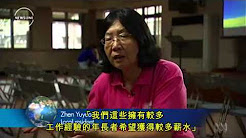
By many accounts, Taiwan has all but eradicated poverty, but this is misleading. Taiwan's poverty line is just too low. Local culture and the government assume family will take care of its own, and that's not always the case. Also if a household has a home, the government considers this an asset that may hurt their ability to receive welfare benefits.
BUDGET IN TAIWAN
Taipei Poverty Line 15, 544 NT a month
minimum wage salary (2018) 22,000 a month
average rent 10,000 NT
average mortgage 20,000
electricity and water 500 NT
cable/internet 800 NT
phone 800
food 16% of salary (2012)
school fees ?
car maintenance/public transportation 13% of salary (2012)
In this Taiwan focused unit, the students will present the articles to the class. Each group has to teach the class 5 vocabulary words, the main idea of the article and provide a group solution to one of the problems in the article. This will be the same as a test.
Introduction Activity: Students roll up a piece of paper into a ball and throw into teacher's basket. The students closest make it, this is representative of privilege.
What is poverty? What is "the poverty line 貧窮界線" ?
Readings 1 and 2 will not be divided according to English proficiency. The handout includes more writing exercises then whats given on this blog page. There will be a test after the 2nd reading to determine who the new A and B class will be.
How do we protect vulnerable children? Complete this table with your partner.
Protect from…
How
Problems / Barriers 障礙,阻礙,隔閡
disease 疾病
EX: vaccinations 給…接種疫苗
EX: who pays for it?
violence 暴力
child labor
gangs 一幫,幫派, 團夥,集團
crime 違法行爲,犯罪活動
drugs 非法毒品
Word Cloud of our first reading
Vocabulary: Instead of using Quizlet, which is great, but they are getting bored, I am going to use a visual Thesaurus and see if they can guess the Chinese meaning.
A new report from the United Nations Children's Fund warns that hundreds of millions of children in the world’s cities are living in poverty[貧困]. UNICEF’s "State of the World’s Children Report" says a staggering proportion of children lack [don't have] the most basic [most important]of services, including clean water, education, health, proper toilets. "Urbanization leaves hundreds of millions of children in cities and towns excluded [outside] from vital services," the Children's Fund said. The Fund also says these children are among the most disadvantaged and vulnerable in the world because they live in fear of violence and exploitation on a daily basis. Millions of children are forced into child labor (work) and the sex industry.
The report explains how the slums where children live have diseases such as pneumonia [肺炎] and diarrhea [腹瀉], two of the biggest killers of children under five in the world. UNICEF spokeswoman, Marixie Mercado, says many children are disadvantaged from birth and are excluded [不包括] from “normal” society [社會] in which richer children can thrive. She says: “One-third of children in urban [city] areas are not registered[登記] at birth [and that] makes them much more vulnerable to exploitation throughout their lives.” UNICEF executive director Anthony Lake added: "Children are vulnerable to.…the injuries[傷害], illnesses [生病] and death that result from [因…發生] living in crowded settlements atop hazardous [dangerous] rubbish [garbage] dumps or alongside railroad tracks."
Write 3 questions on the reading. Write 3 questions about the reading and apply to your life. If you could ask a child slum dweller 3 questions, what would they be?
Also on Netflix with Traditional Subtitles
Reading 1 Ending Discussion:
What are other names for slums? shantytowns, squatters, barrios, favelas,
Where are the world's 200,000 slums? See UN-habitat 聯合國人居署
Why are most slums located on the outskirts of big cities?
What are squatters 非法佔屋? Does Taiwan have squatters?
Why doesn't the government do more to help people in slums?( Many governments don't count slum dwellers in their censuses, let alone measure their sense of security.)
How can slum dwellers help themselves? Akhter Hameed Khan, who in 1980 began mobilizing the community of Orangi, the largest squatter settlement in Karachi, Pakistan. He started a research institute called the Orangi Pilot Project to help residents organize and build a sewer system. Each block collected money and began construction of their own sewers, which served some 90 percent of Orangi's residents by the late 1990s. Between 1982 and 1991, infant mortality rates in the settlement dropped from 130 per thousand to 37 per thousand.
In the slums of Nairobi, communities long neglected by the government are just beginning to gain some level of political effectiveness. In Mtumba, for instance, residents have begun to organize. "On our own," says Tom Werunga, "we have built a school." Four teachers juggle morning and afternoon shifts to teach more than 400 children in three classrooms.
recession (n.) economy going down EX: Demand for new cars has fallen due to the recession.由於經濟衰退,人們對新車的需求減少了
think tank 智庫
international development: the improvement of developing countries (former colonies) to become freer, richer
humanitarian(adj.) devoted to human welfare
marginalized (adj.) excluded from normal society
entrenched (adj.) firmly established, dug in
inequality (n.) lack of equality
economy (n.) the system of buying, selling, distributing resources / economic (adj.) 經濟的
domestic abuse (n.) mistreatment in the home, usually by a man to the woman or children
rates (pl. n.) amount of time something happens, EX: mortality rate 死亡率Infant mortality is much higher in the poorest areas of the city. 在這個城市最貧困的地區,嬰兒的死亡率要高得多。Taiwan Death rate
shrank (past of shrink) to become reduced
domestic chores (pl. n.) housework, EX: cleaning, cooking
hit (v.) to have anegativeeffecton apersonor thing產生不良影響;打擊
EX: Production has been badly hit by the strike.罷工嚴重影響生產。
paint a black/bleak picture of something (Idiom) todescribeasituationorpersonasextremelybad 把(形勢)描繪得很嚴峻;把(某人)說得很壞
sucked into something (phrasal verb) 將…捲入(不快處境或壞事中)
I really don't to get involved in this argument, but I can feel myself being sucked into it.我根本就不想與整件爭論有任何瓜葛,不過我能感覺到自己被牽扯了進去。
It is hardly surprising news, but a new report shows that girls and women are those hit hardest by the global recession. The study is from the organizations Plan International, which is working to reduce [減用] child poverty, and the Overseas Development Institute - the UK's leading [#1] independentthink tank on international development and humanitarian issues. They state that: "The world is failing [辜負] girls and women." The report's author Nigel Chapman said: "Girls are the largest marginalized group in the world." Mr Chapman added: "Much of the problem lies with 'entrenched gender inequality'." Chapman found that a worsening [惡化] economy results [發生] in females of all ages having to work harder and suffering [受折磨] more domestic abuse. Mr Chapman's report highlights a tragic [悲慘的] increase in mortality [death] rates for female infants [babies]. He told the BBC: "The proportion of baby girls who died when the economyshrank rose five times faster than the proportion of baby boys who died….Hence [因此], a 1% fall in economic 經濟的 output 產 量increases infant mortality by 7.4 deaths per 1,000 girls against 1.5 for boys." He paints an equally bleak picture for girls not being able to complete (finish) their education. He reports that the global recession saw a fall in primary [elementary] school completion for girls of 29% compared to 22% for boys. "Girls get sucked intodomestic chores," he said. "Once they stop going to school it's very hard to get back into the rhythm of things."
COMPREHENSION QUESTIONS
1.
What is hardly surprising?
2.
What are the names of the organizations behind the report?
3.
What kind of issues does the Overseas Development Institute deal with?
4.
What, according to the report, is the world doing to girls?
5.
What do women suffer more because of a recession?
6.
What is there a tragic increase in?
7.
What is the ratio of baby girls to boys dying during economic decline?
8.
What kind of picture is painted by Nigel Chapman?
9.
What does the figure of 29% refer to?
10.
What is it hard for girls to do if they stop going to school?
It makes sense to talk about Child Labor after our first two readings as it was briefly mentioned in Reading 1. For the rest of the unit's readings, I will divide them according to English proficiency and use a more detailed ppt in the classroom.
Use picture books that depict how communities have resisted and grown in poverty.
Look for opportunities to engage in joint projects instead of community service with students.
Ask families for input; build home-to-school connections.
Generate and maintain a dialogue between the student and his family around topics related to wealth and poverty.
Leverage community resources.
Offer service-learning that forges partnerships between students and members of the community.
Identify gaps in resources locally—and then examine economic systems of injustice more broadly.
Poverty shopping (Teacher Adam). This is to show the student how difficult it really is to live on a low income.
The class will form groups and will become a family. They will have 20,000 for their group to live on for one month. They must list everything they will buy and the prices. Everything must be realistic.
Once they have completed their list inform them of other cost they may have forgotten.
Rent: $5000
Electric: $1000
Cellphone: $400 per person
Cable TV: $200
Transpiration: $400 per scooter or car
Clothes: $1000
Etc.
Once the class has finished explaining their expenses ask then how much money their families would need to earn to comfortably live. Then ask them what kinds of jobs would allow them to earn that much money.
Explain to them that these are the kinds of jobs that their parents have and this is the kind of situation their parents go thought every month. Explain that the difference between their lives and poverty is not really that great. All it would take is someone losing the ability to make money or having to accept job that pays much less to upset their lifestyle.